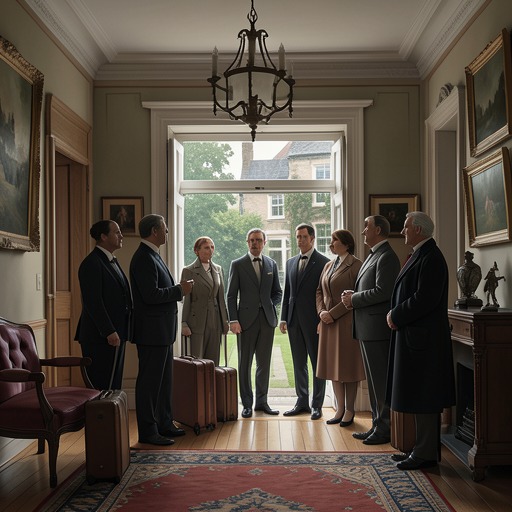
Social snobbery and identity performance
In Search of Lost TimeSocial snobbery and identity performance govern how characters claim belonging, interpret cultural distinction, and revise their loyalties. The novel repeatedly shows that rank is neither simply inherited nor freely chosen: it is enacted through clothes, manners, introductions, artistic preferences, political positions, and the company one keeps. Yet these signs can be misunderstood, and the prestige they confer can change as social alliances and tastes shift. The rise of the Verdurin circle and the Cambremers’ pursuit of aristocratic intimacy illuminate one side of this struggle; the Duke of Guermantes’s change of political allegiance shows how it can reach beyond the drawing room.
Taste, Recognition, and the Verdurin Circle
The Verdurins’ movement toward fashionable society is initially hesitant and partly concealed. The Dreyfus Affair slows their advance, while the arrival of “new” music accelerates it. Their household is treated as a Temple of Music because Vinteuil is said to have found inspiration and encouragement there. His sonata remains little known and largely unappreciated, but his name acquires extraordinary prestige as that of a great contemporary composer. Cultural reputation thus precedes broad recognition of the work itself: the salon’s association with music becomes a resource for social advancement.
That resource circulates through people as well as art. Three young men from the Faubourg study music, and Vinteuil’s sonata becomes fashionable among them. Their mothers, who have encouraged their sons’ education, regard Madame Verdurin with respect when they see her following scores from a concert box. The Verdurins’ changing position is not announced outright; instead, it is legible in these small signs of attention and in the new company drawn toward them. They also want guests to attend dinner in evening dress, a request that makes their aspiration to fashionable recognition visible even as their ascent remains incomplete.
Madame Verdurin’s remarks about the Princesse de Caprarola offer another indication that the circle’s social boundaries are changing. She calls the princess intelligent and charming, remarks that she cannot endure people who bore her, and thereby gives listeners reason to infer that a woman of high society has visited her. The princess has also mentioned the Verdurins to Odette during a visit of condolence after Swann’s death. Odette initially denies knowing them, then describes knowing them long ago, and later presents their new prominence as a development she has noticed from a distance. Her shifting account betrays the tension between her own social ascent and the possibility that another salon is attracting notice.
The Verdurin circle’s new visibility does not mean its members understand social prestige in the same way. Cottard boasts that Madame Verdurin is worth thirty-five million and represents her as a great lady, while suggesting that the Duchesse de Guermantes may be impoverished. He speaks of the Verdurins entertaining the highest nobility and of scientific celebrities being pleased to meet people like himself. His confidence shows how wealth and access can be converted, in his imagination, into proof of rank. The contrast between the Verdurins and the Guermantes is therefore not a simple opposition between the socially successful and unsuccessful: it is also a collision between different measures of distinction.
Theatrical Status and Social Misrecognition
Cottard’s account of fashionable society exposes the role of appearance in making status seem real. The narrator compares social glamour to theatrical costume: elaborate authentic materials may fail to impress, while a designer’s calculated display can make humble materials look sumptuous. Familiarity can also strip high-ranking people of their glamour, while chance may attach the aura of aristocracy to obscure figures. A person dazzled by a titled hostess may therefore mistake an imagined centre of society for a recognised one. Social distinction is not only possessed; it is produced in the observer’s gaze.
The imagery of titles and coronets makes that production especially visible. In Cottard’s understanding, the more doubtful a title, the more prominently a coronet may appear on glasses, silver, stationery, or luggage. Such emblems can sustain a fantasy of living at the heart of the Faubourg Saint-Germain without ensuring that established society recognizes the person displaying them. Cottard’s pride in his social access is consequently real as an experience, but its status value remains uncertain. The novel distinguishes the pleasure of believing oneself admitted from the broader, more elusive fact of belonging.
Cottard’s clothes and vocabulary likewise show social identity being learned and performed. He presents his invitations as evidence that the Verdurins know everybody, explains the difference between a top hat and a trilby, and uses expressions associated with elite sociability with the satisfaction of someone who has mastered them by study. His talk of conversing with aristocrats as an equal reveals both his ambition and his reliance on conventional signs. Yet the narrator’s comparison between people who have grown up among the great and outsiders dazzled by obscure titled figures suggests that rank can lose its aura through intimacy just as easily as it can acquire one through distance.
The Verdurins’ own advance is similarly managed through appearance and timing. Their movements toward fashionable ways are tentative and denied until sufficiently complete, like military objectives not announced before they are reached. Society, meanwhile, is prepared to meet them partway: it can acknowledge them as people no one in Society visits, yet no longer imagine that this exclusion disturbs them. Their salon’s musical reputation helps recast that distance as a kind of cultural independence. The result is a social position in transition, whose participants and observers do not agree on when aspiration has become achievement.
Intellectual Culture and the Pursuit of Rank
The Marquise de Cambremer embodies a different contradiction between cultural cultivation and social ambition. She asks the narrator to tell her about Morel, ostensibly because she adores music and wants to complete her education. She has heard that Morel came with M. de Charlus and hopes to bring the violinist to her own house in order to establish a connection with M. de Charlus. She adds that Brichot interests her too, while concealing the practical purpose behind her inquiries. Cultural curiosity here is genuine enough to provide a social language, but it also serves a deliberate effort to reach connections that seem more exalted and remote.
Her studies do not overcome that ambition. She pursues increasingly recondite philosophy and esoteric music, moving from John Stuart Mill to Lachelier, while seeking to secure a good social position before she dies. Her artistic realism has its own boundary: she accepts humble subjects such as Tolstoy’s peasants and Millet’s rural figures, but does not extend that openness to the limits of her own social relations. The narrator sees an irony in the gap between the intellectual discipline she undertakes and the snobbery that continues to govern her aims. Education supplies cultivated expressions and interests without necessarily transforming the social desires that direct their use.
Her preference for originality over acquired knowledge makes the contradiction sharper. She praises M. de Charlus as naturally gifted and says that she attaches little importance to what is learned; yet the narrator observes that this very distinction is itself a current lesson she has acquired. Her rejection of learning is not outside fashion but part of it. The scene suggests that taste and intellectual manner can operate as forms of distinction even when they present themselves as spontaneous or independent of convention.
Political Conviction as Socially Reversible
The politics of the Dreyfus Affair reveal that identity performance can shape convictions as well as manners. The Duke of Guermantes condemns Swann’s support for Dreyfus as a betrayal of the position he had made for himself. He regards Swann as an intelligent, refined, level-headed man, and finds his political conduct more troubling than that of the younger Saint-Loup, whom he already considers astray. As anti-Dreyfusard opposition grows more violent and becomes social as well as political, the Duke interprets Swann’s stance as a public menace and treats it as evidence against Jews collectively. His reaction makes a political choice into a test of social allegiance and perceived respectability.
The Prince de Guermantes’s account of his estrangement from Swann shows how the division enters intimate relations. The Prince had expected Swann’s views on the Affair to be diametrically opposed to his own and says that hearing them expressed would have been painful. He recalls how the Princess challenged the Grand Duke of Hesse when he said Dreyfus was innocent, and how she later insisted that, as a French Princess, she shared the views of her fellow countrymen. The Prince also recounts that an earlier conversation with General de Beauserfeuil led him to suspect that serious illegalities, rather than a mere error, had occurred in the trial. His narrative makes clear that political positions are discussed and tested within family, aristocratic, and national loyalties, rather than being held apart from them.
The Duke’s later conversion further complicates any simple division between fixed belief and opportunism. After going to a spa, he returns three weeks later as a Dreyfusard. During his stay, he meets an Italian princess and her two sisters-in-law, whose conversation convinces him that they are intellectually superior to him. Invited to play bridge, he begins from his familiar anti-Dreyfusard position, only to find that the women support a new trial and believe Dreyfus innocent. They challenge his attempts to persuade them, and his arguments fail under their criticism. The Duke first repeats their view hesitantly, then returns to Paris a committed Dreyfusard.
The narrator connects this change to a recurring pattern: a person with apparently genuine convictions may be won over when an intelligent couple or charming woman enters his life. The observation extends from private relations to countries that move from hatred of another race to altered alliances within months. The Duke’s reversal is not presented merely as the discovery of new evidence, nor simply as a cynical performance. It is a conversion shaped by intellectual persuasion, social proximity, and the desire to measure oneself against people judged superior. Political conviction, like social identity, remains vulnerable to the company in which it is tested.
Manners, Rank, and the Limits of Performance
Formal conduct offers another stage on which rank is claimed and recognized. At La Raspelière, M. de Cambremer appears to offer M. de Charlus his chair, perhaps from no more than a general wish to be polite. M. de Charlus interprets the gesture as an obligation owed to a prince by a simple squire. He declines the seat with emphatic familiarity, insisting that such precedence is reserved for princes of the blood. The exchange turns an ordinary courtesy into a contest over who may define its meaning. M. de Charlus’s performance asserts inherited rank, but it also depends on persuading those present to accept his interpretation of the gesture.
The broader pattern is one of unstable signs. Evening dress can signal a salon’s aspiration; musical reputation can confer a prestige the music itself has not yet secured; a coronet can intensify a doubtful title; scholarly language can disguise social calculation; and political allegiance can become a marker of respectability. These signs do not carry fixed values. Their force depends on who observes them, what conventions that observer recognizes, and which social group has the power to confer recognition.
The novel therefore treats snobbery not merely as individual vanity but as a mechanism through which society sorts people and distributes prestige. Characters imitate manners, cultivate taste, seek introductions, and interpret political conduct as evidence of character or belonging. Yet performance cannot guarantee admission: Odette’s guarded account of the Verdurins, Cottard’s confident social claims, and the Cambremers’ cultivation all reveal gaps between self-presentation and recognition. Social position changes through encounters and shifting judgments, leaving identity less like a permanent possession than a role repeatedly rehearsed before an audience.